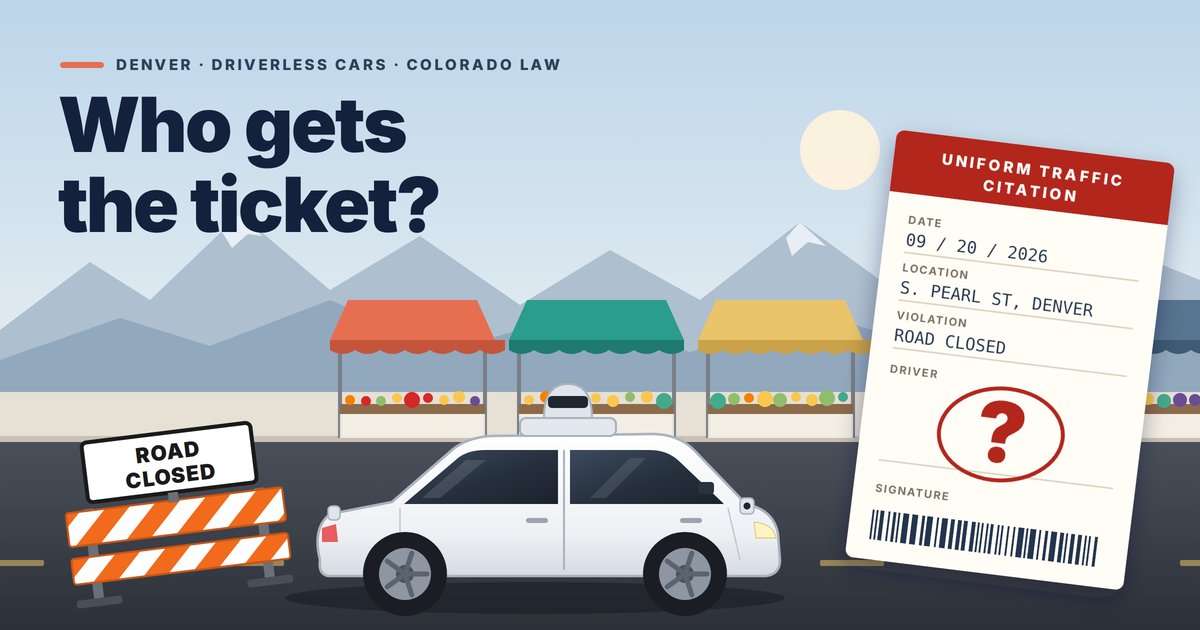
On the morning of Sunday, September 20, a driverless Waymo rolled into the South Pearl Street Farmers Market while vendors were still setting up. It moved slowly between the tents, market staff guided it back out to the street, and no one was injured. It made for a funny clip.
What happened next is more important. Denver Police and the Colorado State Patrol both confirmed that Colorado law has no mechanism to cite a vehicle with no driver. 9News put it plainly: there's no law to ticket the Waymo.
I build AI systems for a living, and I'm not writing this to argue against autonomous vehicles. I expect they will save lives, and I'll probably ride in one this month. But I have never shipped a production system that lacked three things: a named owner, a way to be paged and a way to be shut off. In Colorado law, driverless cars have none of the three.
What happened at the South Pearl Farmers Market
The market's barricades had been moved aside to let vendors load in. According to Denver7, the Waymo followed vendor traffic past the "Road Closed" sign. Nicole Jarman, who runs the market, said it "just joined like it was a vendor." Theodore Subbotin, who manages a farmers market for Hearth Denver, summed up the problem: "There is no driver or anyone in the car… we have to usher it out."
Jarman then asked the question at the center of this whole issue: "How do you communicate with the Waymo?"
Waymo's statement said that "the trust and safety of the community is our top priority." The City of Denver reached out to Waymo through its Department of Transportation and Infrastructure (DOTI) to discuss communication protocols. Both are the right instincts. Neither one is a law.
This is also brand new for Denver. Waymo opened rides to the public on September 1, across roughly 60 square miles of central Denver, from Cherry Creek and Capitol Hill to RiNo and downtown. As of mid-September, 26 vehicles were registered for passenger service, and Waymo says the fleet will grow to hundreds.
Why police can't ticket a driverless car in Colorado
Colorado authorized driverless cars in 2017 with SB 17-213, a bipartisan bill whose prime sponsors were then-Rep. Jeff Bridges, Sens. Owen Hill and Dominick Moreno, and Rep. Faith Winter. It was a forward-looking law, and much of it still holds up. The act says:
- A fully self-driving system (SAE Level 4 or 5) may operate if it is "capable of complying" with every applicable state and federal law.
- Cities and counties can't hold those systems to different standards than human drivers.
- Rules that only make sense for humans, such as needing a driver's license, don't apply to the software.
- Liability for a crash is left to existing state, federal and common law.
The law never says who the driver is when the software is driving. That could be the registered owner, the developer, the fleet operator, the passenger, or a remote operator watching from a building in another state. A traffic citation needs a legal person's name on it, and SB 17-213 never supplies one. The crash-liability clause was no help at South Pearl either, because nothing crashed.
This is not a loophole someone discovered last week. In August 2017, the month the law took effect, the legislature's own nonpartisan staff published an issue brief that listed "determining the 'driver'" as an open question. Two years later, a ready-made fix called the Uniform Automated Operation of Vehicles Act was offered to Colorado. It would have named an "automated driving provider" as the legal driver. Colorado's uniform-law commission voted to introduce it if a legislator would sponsor it. No one did.
Street closures are the hard case
South Pearl was not a random glitch. It belongs to a known category of failure.
In June, Waymo recalled 3,871 vehicles after 12 incidents in Phoenix and the San Francisco Bay Area. In those incidents, cars drove past ramp-closure signs or slipped between cones into active freeway construction. Waymo restricted freeway driving while it fixed the software. That is how a responsible engineering organization should respond. South Pearl was a city-street version of the same problem: a closure that's partly open, with human traffic moving through it on purpose.
Denver closes streets all the time: farmers markets, block parties, parades, festivals, film shoots, and a lot of construction. During testing, Waymos got stuck on Colfax in a construction zone. For this kind of software, those are the hardest situations. The rules for them are written on a sandwich board or signaled by a person waving an arm.
Waymo reports that its cars are involved in 94% fewer serious-injury crashes than human drivers. I take that number seriously. But a safety record and accountability are separate questions. Software improves through incidents, reports and fixes. Colorado law currently offers no way to make sure there is a report, or that anyone answers for what happened between the incident and the fix. I made a related point about AI agents in Three Agentic Patterns Every Python Developer Should Have in Their Back Pocket: once a system acts in the world, someone has to own what it does.
What California and Arizona already do
Arizona is the most useful comparison because it is as welcoming to this technology as Colorado. Its statute uses the same "capable of complying" standard, then adds what Colorado left out: "the person who submits the written statement for the fully autonomous vehicle may be issued a traffic citation." Operators also have to file a law enforcement interaction plan that covers how police deal with the vehicles and who to contact for citations.
California went further. Under AB 1777, which took effect July 1, 2026, police can issue a "notice of AV noncompliance" directly to the manufacturer. The manufacturer has to report it to the DMV within 72 hours. Emergency officials can order a fleet out of an area, and the cars have two minutes to leave. The DMV's implementing rules require a 30-second response on two-way communication links and allow the state to restrict or suspend a company's permit. As one police-trade explainer put it, existing citations "must be issued to a licensed person," so California created a new mechanism.
Colorado has less. First-responder training is a free, voluntary online course built by Waymo and a national highway-safety association. Waymo operates under a luxury-limousine permit from the Public Utilities Commission, which requires crash reports. An incident like South Pearl, with no crash, doesn't trigger any required report.
The report Colorado ordered, and what it got
In 2021 the legislature added C.R.S. 43-1-130, which required CDOT to study autonomous vehicles. The study was supposed to "identify and summarize legal issues relating to the use of autonomous motor vehicles" and be presented to the legislature's transportation committee in 2025.
On October 21, 2025, CDOT presented a 12-slide "Autonomous Vehicle Update." It covers Waymo and Zoox deployment maps, Waymo's safety data, the state's AV task force and CDOT's own autonomous work-zone trucks. It does not address citations, liability or enforcement. Coverage of the hearing focused on safety benefits. The committee recommended no AV legislation. The statute that required the study expired on July 1, 2026, and eleven weeks later a driverless car was in the middle of a farmers market.
What to do if you see a driverless car where it shouldn't be
Most Denverites don't know that no one can be ticketed, or who to call. Here's the short version:
- Treat it as a moving vehicle. Step out of its path, and don't stand in front of it or try to steer it by hand. If anyone is in danger, call 911.
- Document it from a safe spot. Record the time, the exact location, video or photos, and any number or marking on the vehicle.
- Report it to the operator. Waymo takes reports from people who aren't riders through its contact and feedback page. It doesn't list a public phone line.
- Report it to the city. Use Denver's 311 Report an Issue portal, so there's a public record even when no citation is possible.
- If you run a street closure, staff the entrance. For markets, block parties and events, keep a person at any gap in the barricades while vehicles are loading in. A sign alone isn't enough. When you apply for the closure, ask the city how closure information reaches AV operators.
A small fix that doesn't ban anything
Colorado's recent fights over autonomous vehicles have been about whether trucks need a human operator on board. Gov. Polis vetoed that requirement twice, in 2025 and again in 2026, on the grounds that it would effectively prohibit the technology. What's missing now is different. It doesn't prohibit anything or put a human back in the driver's seat. It gives the law someone to hold responsible:
- A named, citable legal driver. One sentence modeled on Arizona's law would do it: the company that vouches for the system gets the ticket.
- Authority to act on repeated violations. A state agency should be able to restrict or suspend operations, as California's DMV can.
- Basic operating protocols. That means a 24/7 contact line for law enforcement, a way to clear vehicles out of emergency scenes and closures, and required reports for incidents like South Pearl even when there's no crash.
The 2027 legislative session opens in January. If you live in Colorado, find your state legislators and ask them one question: "When a driverless car breaks a traffic law in Colorado, who gets the ticket?" Right now there's no answer, and that's the thing to fix.
The 2017 law was written before most of us had seen a car drive itself. Now there's one on South Pearl on a Sunday morning, and the law should catch up. Being accountable doesn't make you anti-technology. It's part of what makes a technology trustworthy.
If you're a Colorado legislator, staffer, event organizer, first responder or reporter working on this, I'd like to hear from you. Use the contact form below.
Lex Gaines is an AI Infrastructure Engineer and founder of LexG.ai and QUASR.ai, building tools and infrastructure that connect AI models to real-world data and systems. He writes from Denver, Colorado.